AI has stopped getting things wrong, but it has become exceptional at producing work that is merely acceptable, and companies are starting to mistake that for progress. As organizations race to automate, leaders must decide which human capabilities are too valuable to optimize away.
That decision starts with identifying the parts of the work where human contribution should remain deliberate rather than quietly ceded to automation. Some responsibilities should always stay with people, no matter how advanced the tools become.
The more capable AI becomes at producing competent work, the more important it becomes to protect human capacity to produce the unexpected. Progress still depends on people who challenge assumptions, exercise judgment, connect ideas in new ways, and imagine possibilities that were not obvious before.
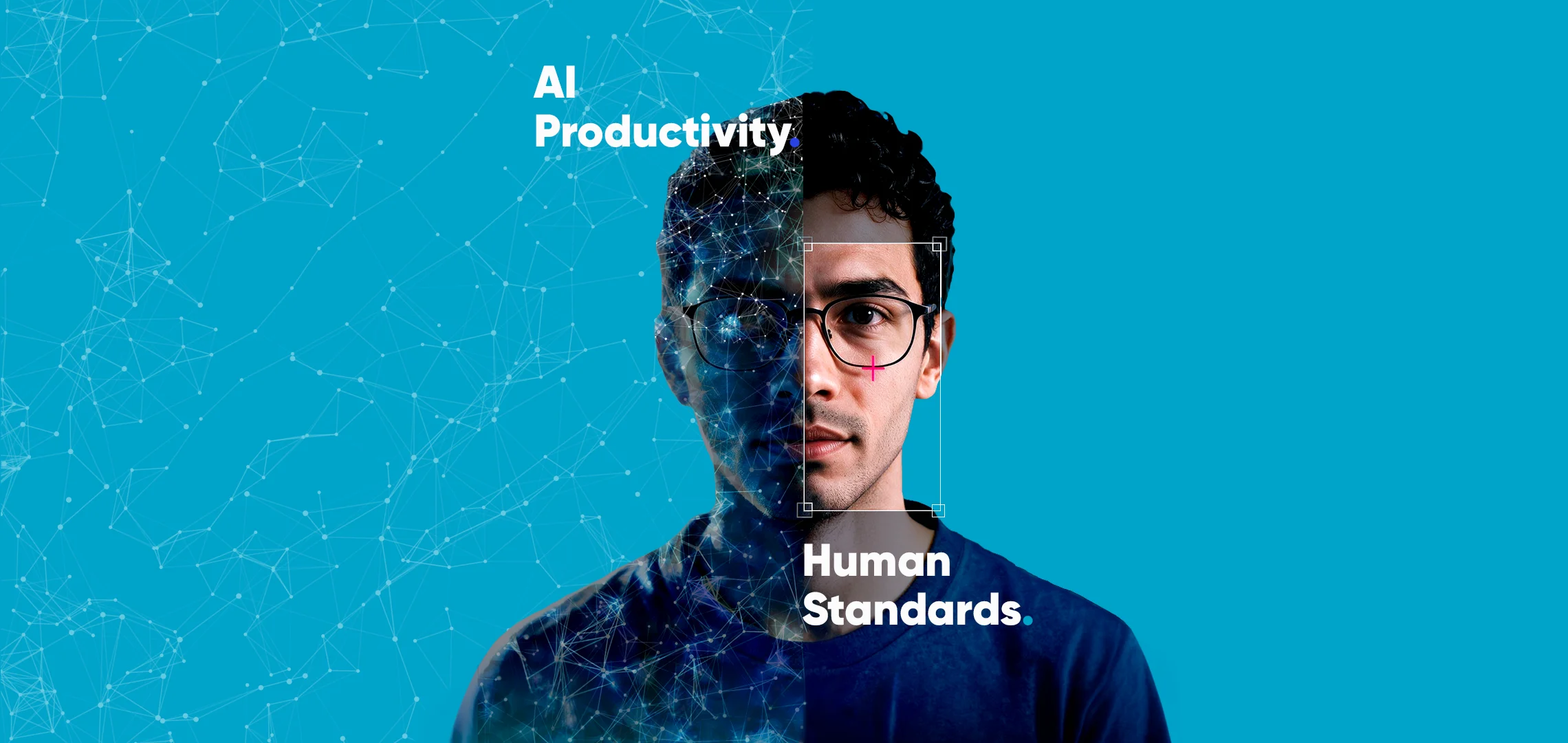
That is the thinking behind AI Productivity. Human Standards, a principle we are bringing more actively into AssureSoft’s philosophy. It means embracing AI’s productivity while protecting human creativity, ingenuity, judgment, ownership, and responsibility that give technology direction and ambition.
This article explores where Human Standards matter most as AI takes on an increasing share of software execution.
The Human Standard is more than a safeguard
As AI takes on more of the work involved in analyzing information, generating options, and accelerating execution, organizations have more room to decide what they want people to contribute differently. The important question is not only where automation should stop. It is what makes standards, judgment, and distinctly human capabilities more valuable as technology becomes more capable.
I think of this as the Human Standard. The Human Standard is the discipline that keeps automation aligned with the company’s purpose, obligations, and values. AI can increase productivity, but people still have to define the level of quality, care, and responsibility that productivity must meet.
But discipline is only half of it. The Human Standard should not only stop technology from taking us somewhere we do not want to go. It should preserve our ability to go somewhere technology could not have chosen for us.
Some of the most consequential ideas do not arrive through an orderly process of optimization. They begin with a question that reframes the problem. An engineer sees that a familiar constraint may not be a constraint at all. A product team connects two unrelated ideas. Someone challenges an assumption that has gone unquestioned for years.
A model can generate surprising combinations and increasingly sophisticated possibilities. But it does not experience an epiphany, care about the future it is trying to create, or take responsibility for pursuing an idea because it believes the world should work differently. What leaders can do is protect the conditions that make them possible: curiosity, room to experiment, time to think, permission to challenge consensus, and enough ownership for people to pursue an idea before its value is obvious.
That distinction is becoming more important. McKinsey’s recent work on leadership in the AI era highlights setting aspirations, making difficult decisions, and generating original ideas as examples of work in which human capabilities remain central.
AI can predict from what has already happened; human judgment can decide when the future should look different.
That may ultimately be one of the most important human contributions left to protect.
When execution scales faster than accountability
A model can identify patterns and produce a plausible recommendation, but it cannot fully understand the business consequences surrounding that recommendation.
That is one organizational risk. There is another: when plausible, competent answers become abundant, organizations may gradually stop asking whether those answers are ambitious enough.
The danger is not only that AI produces something wrong. It is that it becomes extremely efficient at producing something acceptable, and teams begin confusing acceptable execution with original thinking.
Without a person who rises up to the decision, the company loses the ability to question the outcome, correct the process, and change the assumptions behind it. AI can produce or trigger a result, but it cannot decide that the system itself needs to change. Human ownership matters because someone has to learn from what happened.
Let’s raise the stakes. What happens when the “responsible party” is an AI system rather than a person? A model cannot be held accountable in any meaningful sense. If no person is responsible for reviewing the result, tracing the failure, and changing the workflow, the organization may keep repeating the same mistake with greater speed and scale.
This is where responsible AI becomes more than compliance. BCG has argued that responsible adoption should combine clear governance with human-AI collaboration and risk-based decision-making, allowing organizations to scale AI without treating safeguards and innovation as opposing goals.
The point of those frameworks is not to put humans at the end of the process as inspectors. It is to preserve human agency throughout the process: someone who can challenge the output, change the framework, question the objective, or pursue a better idea altogether.
The decisions technology leaders cannot delegate to AI
The CEO sits at the intersection of pressures that no single department sees in full. That vantage point makes the role responsible for seeing the whole system and deciding where acceleration creates value and where it begins to weaken the company.
The World Economic Forum makes that leadership responsibility explicit in its 2025 responsible-AI playbook. It identifies C-suite and board sponsorship as fundamental to aligning AI governance with broader business strategy.
This matters because what gets optimized tends to shape what survives. If AI adoption is measured primarily by hours saved, costs reduced, or work produced, companies can unintentionally signal that speed is the standard. Leaders have to make clear where efficiency matters, but also where judgment, experimentation, debate, and original thinking matter more.
One assumption deserves particular scrutiny: if AI can accelerate a process, that process should be accelerated. Some work is slow because it is inefficient, but some work takes time because it requires review, debate, exploration, or careful judgment.
Removing unnecessary friction is progress; removing the thinking that protects important decisions is not. Neither is removing the thinking that creates new and better ideas.
For technology-driven companies especially, leadership now includes protecting work that may initially look inefficient precisely because discovery is not always efficient. Not every useful conversation has an immediate deliverable. Not every experiment succeeds. Not every unconventional idea can demonstrate its ROI before someone has had the chance to develop it.
If leaders optimize all of that away, they may create an organization that executes faster while becoming less capable of imagining new and exciting possibilities.
If the Human Standard changes nothing, it means nothing
The Human Standard only matters when it changes how the company operates.
The vision is larger than preventing a company from crossing the wrong line. As AI becomes increasingly capable, leaders have an opportunity to give people more room to do the work that only people can truly excel at: imagining, questioning, creating, and deciding.
That requires protecting the conditions where those qualities can thrive. People need to feel motivated enough to challenge the obvious answer, trust enough to pursue an unconventional idea, and space enough to think beyond the next deliverable. Leaders must ensure that productivity does not become the sole measure of progress.
Because the real promise of AI is that greater productivity can give talented people more capacity to explore what human ingenuity can build with this new tool.
That is the balance behind AI Productivity. Human Standards.