
Artificial intelligence has become one of the biggest strategic investments for modern enterprises. From generative AI copilots to large language models (LLMs), organizations are racing to automate workflows, accelerate decision-making, and improve operational efficiency. Yet many companies underestimate the true cost of AI adoption because the most expensive challenges rarely appear in the initial business case. The real financial burden often emerges after deployment, when teams face data issues, operational complexity, governance requirements, and declining trust in AI outputs.
Most AI budgets focus on obvious expenses such as infrastructure, licensing, cloud consumption, and model access fees. However, enterprise AI initiatives introduce an entirely new operational ecosystem that requires constant monitoring, validation, security oversight, and cross-functional alignment. Without proper planning, these hidden costs can quietly erode ROI and delay the value organizations expect from AI transformation initiatives.
The Real Problem With AI Budgeting
Many organizations still evaluate AI implementation using a narrow financial lens. Budgets typically include software subscriptions, cloud services, engineering resources, and perhaps some user training. What often gets overlooked is the operational infrastructure needed to sustain AI systems over time. Once models move into production, businesses must manage governance, monitoring, retraining, compliance, and quality assurance on an ongoing basis. According to McKinsey research on AI adoption, operational readiness and data quality remain some of the biggest barriers to successful enterprise AI scaling.
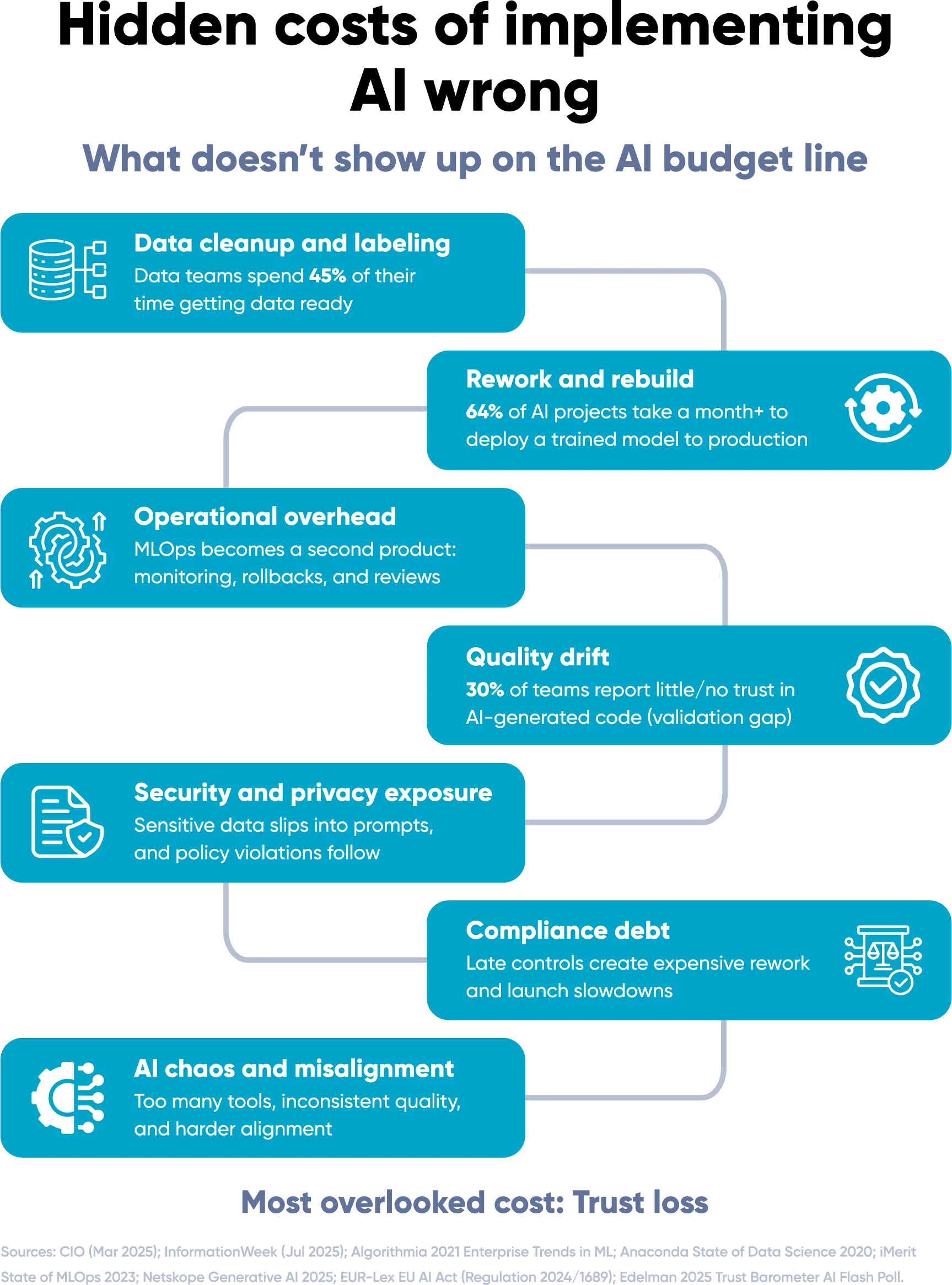
This gap between projected and actual costs explains why many AI initiatives fail to scale successfully. Companies frequently discover that deployment is only the beginning of the investment cycle. The infographic below highlights some of the most common hidden costs associated with enterprise AI implementation.
Data Preparation Takes More Time Than Expected
AI systems depend heavily on high-quality data, but most organizations operate with fragmented, outdated, or inconsistent information spread across multiple platforms. Before models can deliver meaningful outputs, teams often spend significant time cleaning, organizing, labeling, and validating data. This process is one of the most hidden costs in enterprise AI implementations because it directly impacts deployment timelines and model performance.
Without a strong data foundation, organizations frequently experience delays, inconsistent outputs, and rising operational costs. Businesses that invest early in data governance and quality management are generally better positioned to scale AI initiatives successfully and reduce long-term inefficiencies.
Common Data Challenges
- Inconsistent legacy systems
- Duplicate or missing information
- Unstructured business documents
- Manual data labeling
- Lack of centralized ownership
AI Projects Often Require Rework Before Production
Many organizations successfully develop AI prototypes but struggle to operationalize them in real business environments. Moving from experimentation to production requires integration, governance, infrastructure planning, and workflow adaptation that are often underestimated during the early stages of implementation.
As AI systems interact with evolving business conditions and real-world inputs, organizations frequently revisit prompts, workflows, APIs, and validation processes before reaching production stability. This creates delays, additional operational costs, and ongoing maintenance challenges that can significantly impact ROI expectations.
| Challenge | Business Impact |
| Poor integration planning | Deployment delays |
| Low-quality data | Inconsistent outputs |
| Weak testing processes | Higher failure rates |
| Lack of governance | Compliance bottlenecks |
MLOps Creates Ongoing Operational Complexity
Deploying AI models is only the beginning of the operational lifecycle. Organizations must continuously monitor performance, detect drift, optimize infrastructure costs, manage updates, and maintain governance controls. This operational layer, commonly known as MLOps, quickly becomes essential for maintaining scalable and reliable enterprise AI systems.
Without proper oversight, AI performance can decline over time due to changing data, evolving user behavior, or shifting business requirements. Long-term success depends on continuous monitoring, observability, and governance strategies that allow organizations to maintain quality and operational consistency.
Key MLOps Responsibilities
- Performance monitoring
- Drift detection
- Security auditing
- Version management
- Cost optimization
- Governance enforcement
Security and Compliance Risks Continue to Grow
As organizations expand the use of generative AI across departments, security and compliance concerns become increasingly important. Employees may unintentionally expose sensitive information through prompts, workflows, or external AI tools if proper governance policies are not established early in the implementation process.
Modern regulations such as the GDPR and the EU AI Act are forcing businesses to strengthen governance frameworks for AI use. Organizations looking to improve operational oversight should explore our AI Governance Best Practices resource for additional guidance on responsible AI implementation.
Companies adopting enterprise AI should also evaluate secure infrastructure and enterprise-grade Enterprise Data Security Solutions to reduce operational risk and strengthen compliance strategies.
Trust Is Critical for Long-Term AI Adoption
One of the most overlooked challenges in enterprise AI is the loss of trust caused by inaccurate outputs, inconsistent responses, or weak governance controls. When employees lose confidence in AI systems, adoption slows, and teams revert to manual validation processes. This reduces productivity and limits the long-term business value AI was expected to deliver.
Trust is built through transparency, governance, monitoring, and human oversight. Organizations that prioritize these elements early are far more likely to scale AI successfully while maintaining operational reliability and business confidence.
Final Thoughts
Enterprise AI implementation involves far more than deploying models or purchasing software licenses. The biggest challenges often emerge after deployment through operational complexity, governance requirements, security concerns, and long-term maintenance. Organizations that prepare for these hidden costs are significantly more likely to build scalable and sustainable AI ecosystems.
AI success requires governance, scalability, and operational alignment from day one. If your organization is planning to scale AI initiatives securely and efficiently. Contact our AI experts today.