How shared engineering knowledge accelerated AI-powered delivery
From individual expertise to collective productivity
A practical case study on how AssureSoft engineers used AI to capture, structure, and reuse technical knowledge across software workflows.
This case shows how shared knowledge became the foundation for stronger AI-powered teamwork, helping engineers reduce repeated analysis, apply standards more consistently, and turn individual learning into reusable team capability.
88%
Increase in team output in 90 days
73%
Average high-specificity prompt rate
100%
Active AI utilization across the cohort
8
teams
Building a shared knowledge system
THE CONSTRAINT
Eight teams, one recurring problem
For this client, eight engineering teams worked across multiple repositories, technologies, and delivery processes within a healthcare software environment subject to HIPAA requirements. Day-to-day, this created constant context switching among development, code review, troubleshooting, and documentation, while critical knowledge remained scattered across people, tickets, and undocumented decisions.
None of them set out to build an AI system. They set out to solve a more familiar problem: engineering throughput needed to grow, but not at the cost of consistency or regulatory compliance in a codebase spread across dozens of repositories and shaped by years of decisions nobody had fully documented. Handing every engineer an AI license wasn’t going to close that gap on its own. The real constraint was how well knowledge moved between people.
That constraint showed up in the same four ways:
1ST CONSTRAINT
Cognitive overload
Engineers managed multiple repositories and services simultaneously, maintaining context across systems without tooling support.
2ND CONSTRAINT
Fragmented knowledge
Expertise lived in people, not systems. Onboarding and architectural decisions depended on who you asked.
3RD CONSTRAINT
Non-scalable practices
Strong patterns that one engineer developed rarely transferred to another team without manual rework.
4TH CONSTRAINT
Context-switch tax
Moving between the ticketing system, the repo, and the docs created constant interruptions, slowing both delivery and decision quality.
Two of those eight teams, referred to here as Team Meridian and Team Catalyst, produced the clearest evidence of how to address that problem. This case shows how their work began to shape the model being extended to the other six teams.
“The real challenge in engineering at scale is not writing code faster. It’s understanding systems faster, making better architectural decisions, and ensuring that what one person learns today becomes a capability the whole team has tomorrow.”
- Engineering Manager
THE CONSTRAINT
Adoption rooted in real needs
The first use of AI came from the engineers already on these teams, who reached for it to debug, document, and plan faster on their own before there was any shared playbook for it. That phase mattered because it showed where AI was actually useful in real engineering work.
Some of the eight teams used it to improve sprint visibility. Others leaned on it for architecture, maintenance, code review, testing, or troubleshooting. The pattern that emerged mattered more than any single use case: individual habits, developed independently across different teams, were starting to look like something worth sharing.
That unstructured phase taught the team where AI already worked. The next move was making that pattern repeatable across all eight teams.
THE SHIFT
From individual habit to shared infrastructure
The inflection point came when individual habits stopped being personal and started being treated as shared infrastructure the whole organization could draw on. The question shifted from “How does AI help this person finish this task?” to “How can AI make what this person just learned available to other teams?”
This shift turned isolated productivity gains into reusable knowledge, standards, components, and workflows. Some directly expanded what teams could accomplish with AI. Others provided the engineering foundation needed to apply it consistently, securely, and at scale.
What the team made reusable
SHARED ASSET | HOW IT SUPPORTED TEAMS AND AI-ASSISTED DELIVERY |
|---|---|
Centralized knowledge bases | Made technical and project context easier for engineers to access and for AI tools to use when relevant |
Development standards | Helped teams apply consistent coding and architectural patterns as AI-assisted work expanded |
Code review rules | Established shared quality expectations for both human-written and AI-generated code |
Specialized AI agents | Added speed and structure to recurring engineering workflows |
Sprint-tracking tools | Gave teams clearer visibility into progress, blockers, and productivity patterns |
Testing frameworks | Accelerated validation and carried proven testing practices into future work |
Shared libraries/components | Allowed teams to reuse prompts, components, configurations, and implementation patterns |
AI tool integrations (ticketing, repo, docs) | Reduced context switching by linking information across tickets, repositories, and documentation |
Security and compliance controls | Helped teams apply quality, security, and HIPAA requirements as delivery accelerated |
These shared capabilities became more valuable when connected to the tools engineers already used. AI became part of the development environment, drawing context from tickets, repositories, documentation, and engineering knowledge bases.
How AI was integrated into the engineering stack
TOOL/PLATFORM | ROLE IN THE STACK | ROLE IN THE STACK |
|---|---|---|
AI-powered IDE (Integrated Development Environment) | Primary development environment for code generation, analysis, and multi-repository context management | Core |
Ticketing system | Sprint data source for AI-generated standup reports and blocker detection | Integrated |
Code repository | Cross-repository impact analysis and standards validation | Integrated |
Documentation platform | Knowledge base hosting that feeds context into AI workflows | Integrated |
Specialized AI agents | Custom agents for code review, migration planning, security validation, documentation | Custom-built |
Knowledge bases | Encoded standards, architectural context, HIPAA constraints, lessons learned | Custom-built |
Together, these integrations gave AI access to the same technical context engineers used every day. The result was a connected engineering system where tools, knowledge, standards, and human oversight worked together throughout delivery.
That shared context also changed what could scale. A workflow refined by one engineer could be reused by another without having to reconstruct the reasoning behind it. Standards traveled with the work, lessons remained available after each task, and AI-assisted practices could move across teams without losing the human judgment that made them reliable.
PROOF AT SCALE
Team Meridian’s migration: the flagship case
Team Meridian is one of those eight teams, and its migration is the number that should make a CTO stop and ask how.
A cross-repository search infrastructure migration was scoped for four developers over four weeks, totaling approximately 640 engineering hours. The scope included multiple repositories, tangled service dependencies, and cross-component compatibility requirements.
Team Meridian started by building a knowledge base: system structure, service dependencies, coding standards, security requirements, and review protocols. Specialized AI agents were configured to apply those standards consistently across every repository. Only after that foundation was in place did migration work begin.
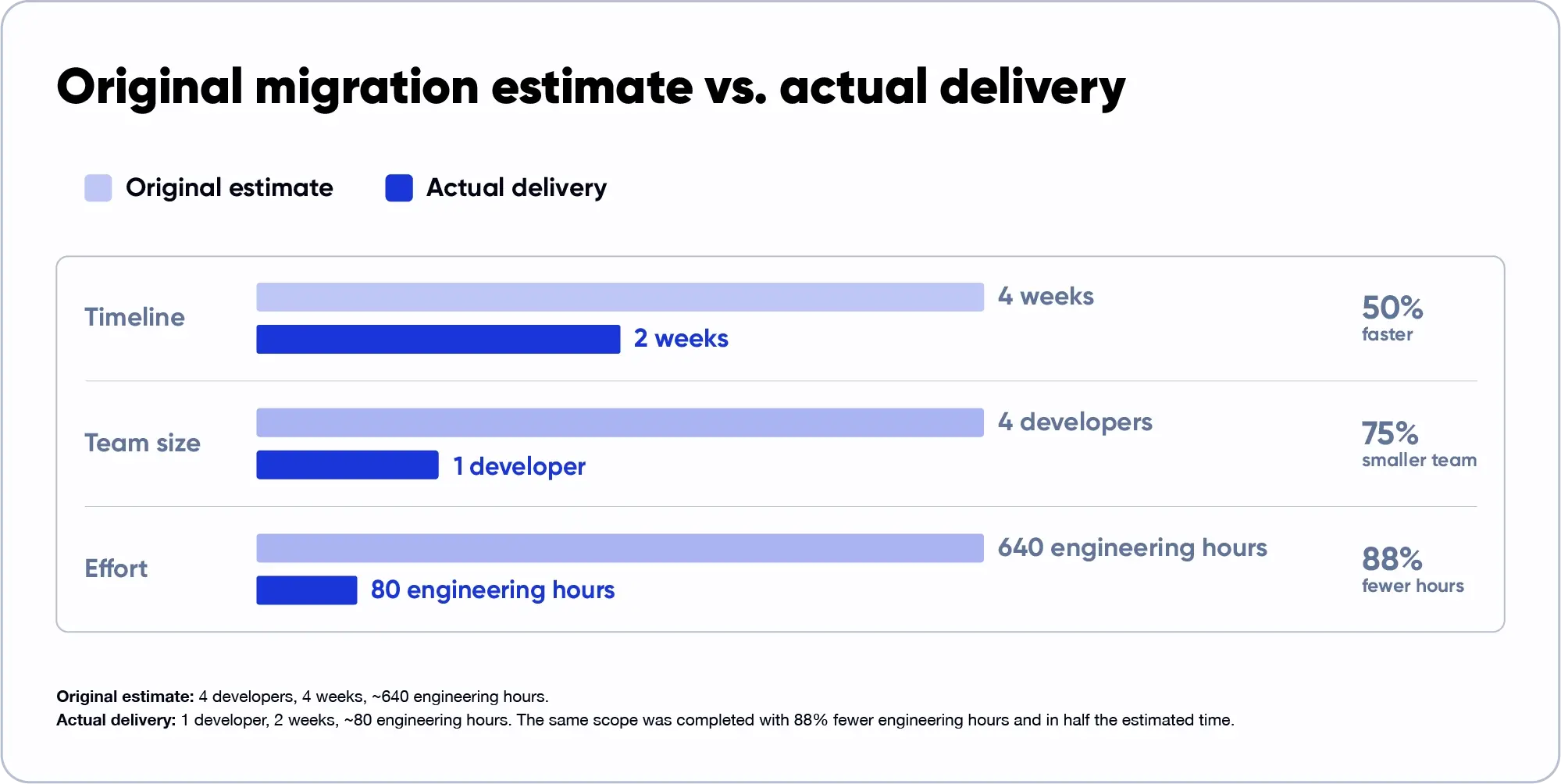
Encoded, machine-readable context enabled one engineer to maintain architectural context across a distributed system while following established quality standards and review protocols.
KEY PROCESS | WITHOUT AI | WITH AN AI-AUGMENTED KNOWLEDGE BASE |
|---|---|---|
Cross-repo context management | Manual, error-prone, dependent on whoever knew the system | Automated context retention across all repos |
Ticketing system | Hours of manual, service-by-service review | Near-immediate identification of affected components |
Code repository | Post-hoc review with a risk of validation gaps | Encoded security requirements with human review |
Documentation platform | At risk of being lost when an engineer left or rotated off | Persisted in the knowledge base, reusable by anyone on the team |
COMPOUNDING RETURNS
Team Catalyst: built to be reused
Team Catalyst expanded AI beyond lookup, using it as a planning partner before any code was written. Their rule was simple: specify thoroughly before generating so that what they built would be worth keeping.
That upfront investment produced libraries, components, and integration patterns designed for reuse from day one. Each subsequent project got faster and more reliable than the last:
- Components built for one project helped reduce scoping time for the next
- Shared libraries helped reduce integration risk
- Reusable testing frameworks helped streamline QA work
The honest part of the story: adoption was not immediate across the team. One engineer initially continued using the existing manual workflow. As reusable AI-assisted practices demonstrated clear advantages in planning and delivery, the engineer adopted the shared approach without requiring a mandate.
None of this is worth much if it can't be measured. The next question the team asked was how to tell good AI use from just frequent AI use. Adoption could show that engineers were using the tools, but it could not explain whether those habits were becoming disciplined, repeatable, and relevant to production work.
To understand that difference, the team looked beyond activity alone and examined the patterns behind it. What emerged was a more useful picture of maturity, one that connected everyday behavior with the quality and purpose of AI-assisted delivery.
MEASURING MATURITY
The signals behind effective AI use
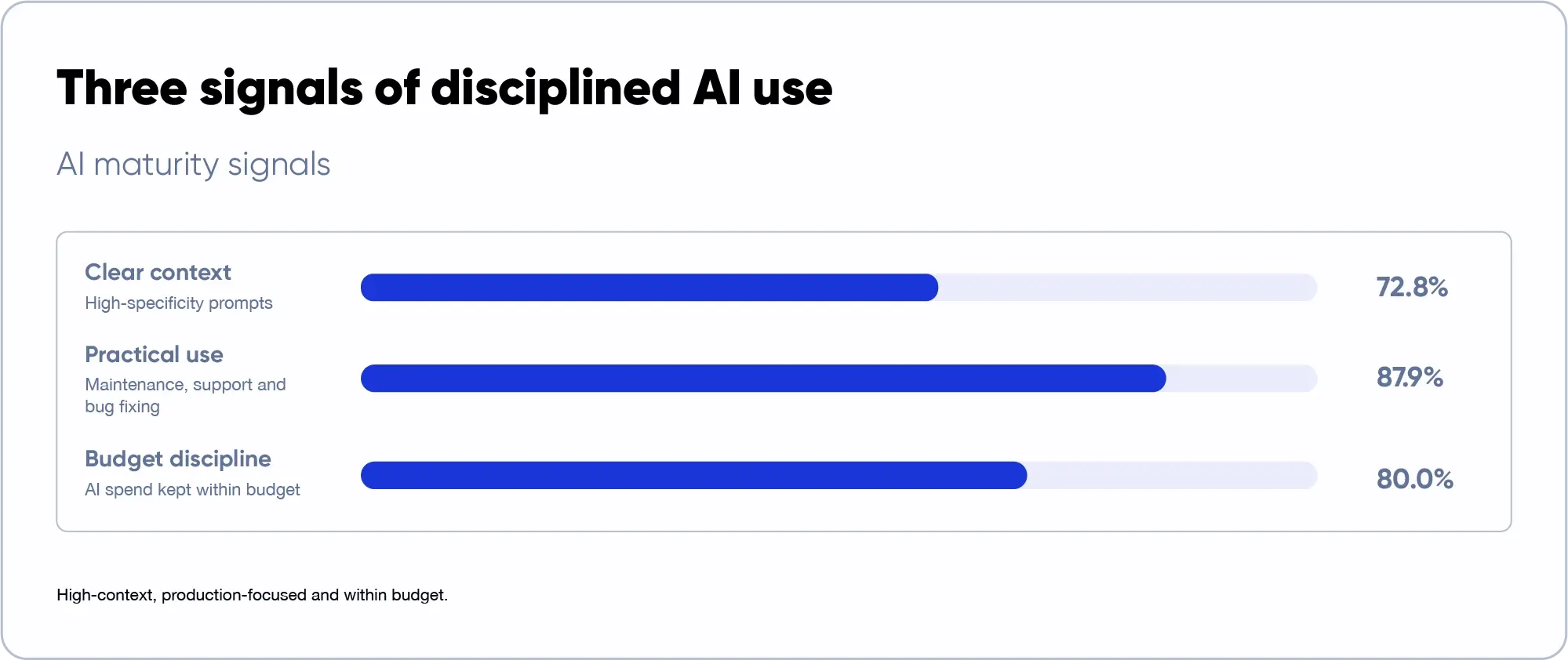
Within a 15-engineer measurement cohort, AI utilization was evaluated against a defined monthly tool budget. Spend and usage data provided visibility beyond adoption, showing how actively the tools were being used and whether investment remained within plan.
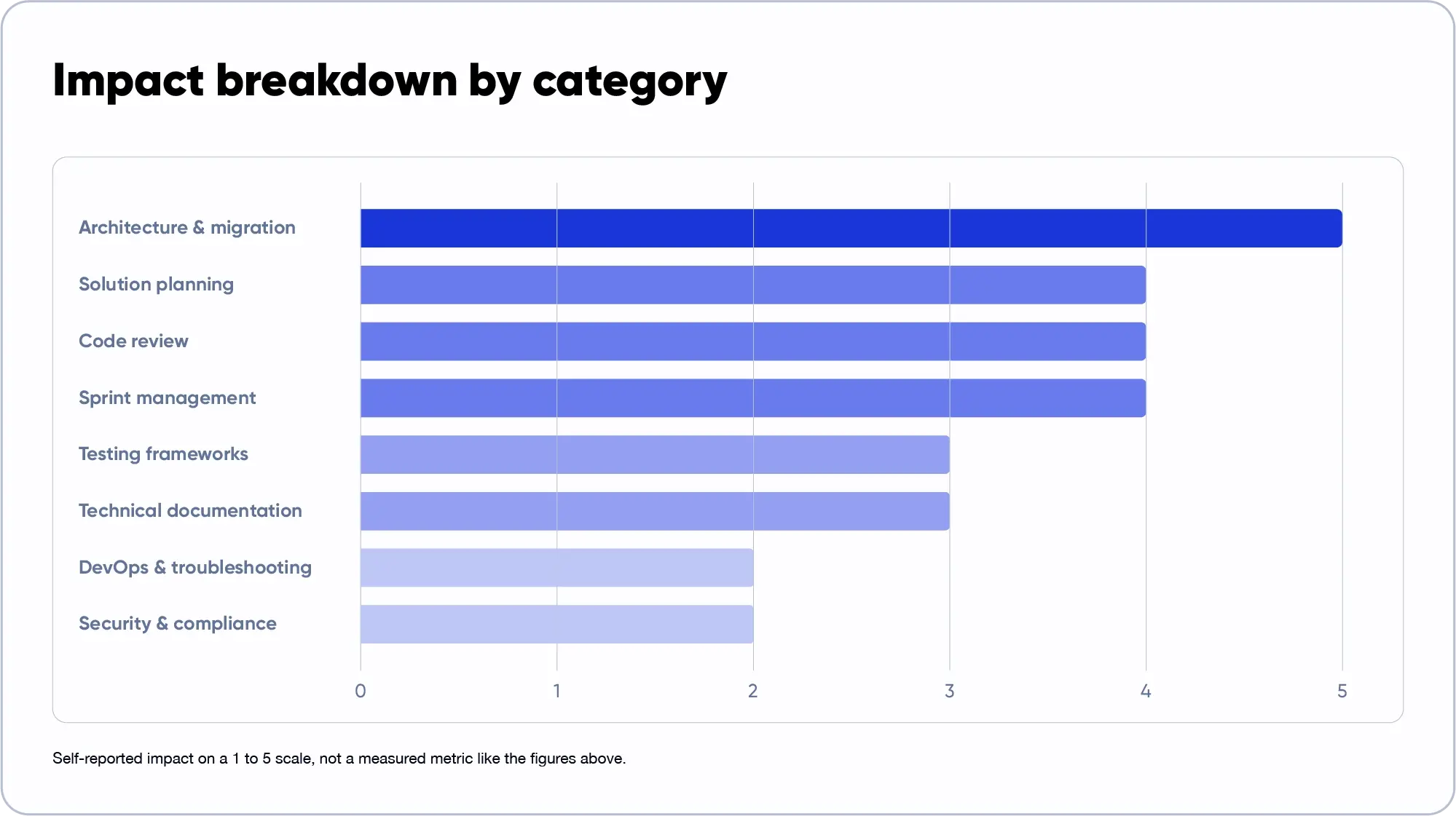
The teams also self-reported where AI had made the greatest difference in their day-to-day work. This qualitative signal was tracked separately from system-measured data:
Beyond the measured utilization data, the teams rated AI’s perceived impact across eight areas of their engineering work:
WHY IT WORKED
The five conditions that made adoption stick
1.
Organic starting points
The most durable initiatives began with an engineer’s personal pain point, not a directive. Self-identified problems create ownership; top-down mandates create compliance.
2.
Knowledge encoded in systems, not people
Team Meridian’s decision to build a knowledge base before the migration was the highest-leverage investment in the entire program.
3.
Integration with tools already in use
AI plugged into the ticketing system, the repo, and the docs the team already worked in. It became part of the workflow instead of one more tab to context-switch into.
4.
Individual assets converted into team assets
The inflection point in maturity is the moment a personal productivity trick becomes a shared, distributable resource for all teams.
5.
Human judgment as the non-negotiable standard
In a HIPAA-regulated environment, unreviewed AI output isn’t an option. Security validation and human review are part of every AI-assisted workflow.
THE OUTCOME
Results that compound
Fewer hours on a cross-repository migration
The same scope was completed in approximately 80 engineering hours, instead of the 640 originally estimated, while maintaining the architectural context, quality standards, and human review.
Average high-specificity prompt rate
Across the analyzed engineers, nearly three in four prompts included detailed context and instructions, indicating a more deliberate approach to guiding AI within engineering workflows.
Active AI use across the measured cohort
Every engineer in the cohort actively used AI tools. Adoption developed organically as shared practices demonstrated practical value in everyday engineering work.
Building a shared AI knowledge infrastructure
Knowledge bases, standards, agents, frameworks, and lessons learned are being connected so that effective practices can move between teams instead of remaining with individual engineers.
“The true indicator isn’t that we completed the migration faster. It’s that one person could maintain the full context of a distributed system across multiple repositories and services, without losing consistency or quality. That’s a different kind of engineering capability.”
- Engineering Manager
Each of the eight teams now holds a piece of this capability. The next phase will help ensure that no engineer has to rediscover what another team has already learned.
NEXT STEP
Eight teams, one shared capability
The flagship migration completed the same scope with 88% fewer engineering hours, showing what one team could achieve when AI was supported by the right context, engineering standards, and human oversight. The larger opportunity is to make that capability available across all eight teams.
Each team has developed valuable AI expertise within its own domain. The next phase will bring those practices into a shared capability layer that every team can use, improve, and extend.
Universal knowledge hub
The best practices, agents, and frameworks each team built, generalized so any engineer on any team can draw on them.
Cross-team showcases
Regular sessions where teams demonstrate their AI workflows to each other, creating horizontal transfer without top-down coordination.
Client-facing visibility
Analyzing AI utilization and delivery data to demonstrate not just adoption, but measurable impact on outcomes.
For CTOs, this is where the value begins to compound. Knowledge captured by one team can reduce repeated analysis for the next, improve consistency across repositories, and make delivery impact easier to measure.
AI access is now widespread. Engineering leaders should evaluate whether a software development partner can turn individual expertise into reusable systems, maintain quality, security, and accountability as adoption expands, and demonstrate measurable results. This operating model turns isolated gains into a shared engineering capability that grows with every project.


To learn how this
model could work for
your team, contact us