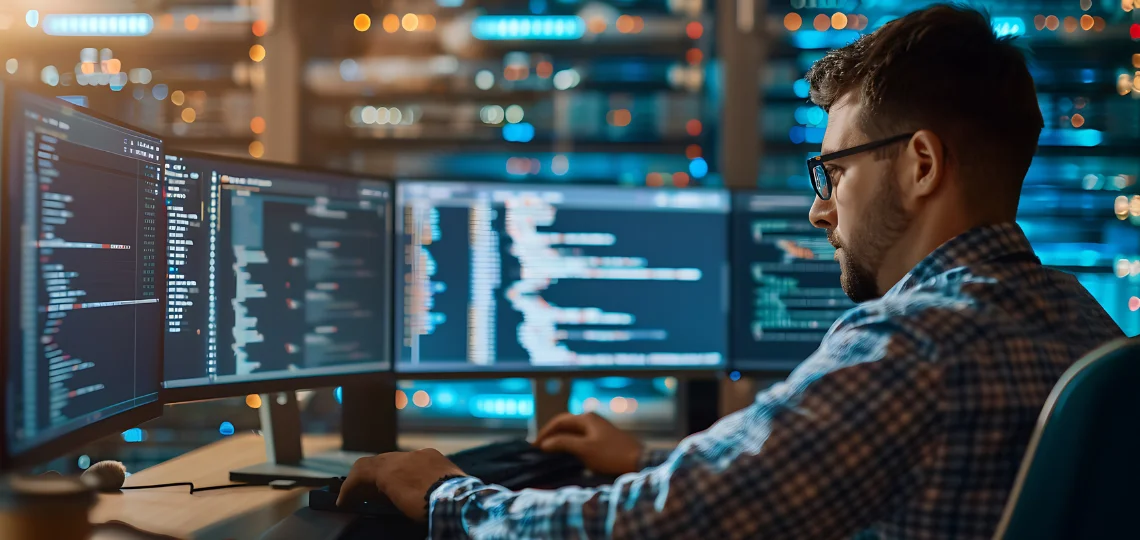
3:14 a.m. The on-call engineer gets paged. Dashboards are green: uptime is fine, latency is fine, error rate is near zero. But support tickets are climbing fast. The AI agent handling tier-one requests is responding quickly and confidently, and it's been giving wrong answers for the better part of an hour. Nothing in the traditional monitoring stack caught it, because nothing was actually down.
That scenario is becoming common enough that it's reshaping what site reliability engineering has to cover. Google's own SRE practice notes that changes account for roughly 70% of production outages, which is exactly the kind of failure error budgets and rollback discipline were built to manage. AI systems add a failure mode traditional SRE was never built to catch: fully "up," responding fast, and still wrong.
What the Postmortem Would Have Needed to Catch It
Four practices are specific to AI systems and would have surfaced the 3:14 a.m. incident well before support tickets did. Output quality monitoring tracks whether the model's actual responses are degrading in quality or accuracy, not just whether the service is technically responding. Drift detection catches when real-world usage patterns diverge from what the system was built and tested against. Guardrail and safety monitoring matters especially for agentic systems capable of taking action, where a "successful" response can still be the wrong one to have acted on. And cost-aware incident response catches the adjacent failure mode: a misbehaving system stuck in a retry loop calling an expensive model repeatedly, turning a quality incident into a cost incident too.
What Wouldn't Have Changed
A meaningful portion of SRE discipline would have applied exactly as written. Uptime and latency monitoring is still essential, since a slow or unavailable AI service is a real reliability problem regardless of what's happening inside the model. Incident response processes are largely unchanged in structure, though the diagnostic steps for an AI-related incident look different. Capacity planning and autoscaling are still critical, though AI workloads scale less predictably than typical application traffic. On-call rotations and escalation paths are structurally similar, just extended to cover AI-specific failure signals.
| Practice | Traditional SRE | AI-Specific SRE |
| Primary failure signal | Errors, latency, downtime | Same, plus output quality degradation |
| Incident triggers | Outages, performance regressions | Same, plus drift, guardrail violations, cost spikes |
| Rollback strategy | Revert code deployment | Revert code and/or model version |
| On-call diagnostic skills | Infrastructure and application debugging | Same, plus evaluation and model behavior analysis |
Building This Into an Existing Team
Most organizations don't need to build an entirely separate AI SRE function. What tends to work well is extending existing SRE practices by bringing in engineers with AI-specific monitoring and evaluation experience to work alongside the infrastructure team that already understands the rest of the production environment. This mirrors the approach described for MLOps and DevOps in production AI systems, and connects to the broader case for building evaluation infrastructure before launch.
How AssureSoft Builds AI Reliability
Our infrastructure engineers bring direct experience building the monitoring, evaluation, and incident response practices AI systems specifically need, not traditional SRE applied to AI workloads without adaptation. We help companies catch the quiet failures, output degradation, drift, and cost spikes, that traditional monitoring alone won't surface.
AI Productivity. Human Standards.
Ready to build reliability practices built for AI, not just adapted from traditional software? Let's talk.