From days to hours: Scaling AI-assisted testing in legaltech
Testing at the speed of the roadmap
A 12-person AssureSoft team helped a global legaltech provider reduce automated test creation time by an estimated 75%, expand scalable QA practices, and protect the connected workflows legal professionals rely on.
75%
faster
Compared with the original engineering effort estimate
12
engineers
Across software development, QA, and DevOps
Reusable
assets
Including playbooks, libraries, frameworks, agents, and technical guidelines
The client provides a connected ecosystem of legal technology and AI solutions for document drafting and review, knowledge management, transactions, and firm operations, serving more than 15,000 customers worldwide. As its portfolio grew, the client needed faster testing to keep pace with new features without weakening release quality.
AssureSoft turned automated testing from a delivery constraint into a scalable capability. By combining AI-assisted generation with QA expertise, reusable frameworks, shared context, and accountable review, the team accelerated test creation while strengthening the quality practices behind each release.
Core result: The team increased test automation capacity, brought QA earlier into feature development, and created reusable practices that helped product teams release with greater speed and confidence.
THE CONTEXT
Legal workflows leave little room for regressions
The client’s technology supports the work legal professionals depend on every day, from drafting and reviewing documents to accessing firm knowledge, completing transactions, and managing essential operations. In these workflows, software reliability directly affects productivity, client service, and trust.
Because these workflows are closely connected, a change in one product area can affect features, integrations, and user journeys elsewhere. As the roadmap and its AI-powered capabilities expanded, regression coverage had to keep pace to protect the broader ecosystem.
This reach makes software quality a business concern. A regression could disrupt document workflows, create uncertainty during review, or add friction to work shaped by tight deadlines and high client expectations.
Automated tests were essential to protecting this reliability. Yet creating reliable tests required specialized coding skills, repeated environment and framework setup, and several days for complex scenarios. This limited how quickly coverage could grow as new features and AI-powered capabilities reached the product.
For parts of the product without automated coverage, teams relied on manual checks before each release. When something slipped through, lawyers were the ones who found it, whether as a review screen that no longer loaded or an export missing a flagged clause, often in the middle of a deal.
Where AssureSoft matters: AssureSoft expands the engineering system that drives the product roadmap. The engagement adds specialized development, QA, and DevOps capacity inside the client’s workflows, then turns local improvements into reusable practices that internal teams can apply.
What the team made reusable
AI-enabled legaltech products must work within tools and workflows where safety and transparency shape adoption. This expectation creates the engineering requirement that teams must build and validate changes quickly without weakening controls that support reliable releases.
To see this application in practice, take contract review, one of the product’s core workflows. Lawyers load a stack of agreements, see which clauses the software flagged, compare versions, and export their findings. As new AI-powered capabilities were added to those steps, every release touched screens people already depended on. Tests had to walk through those same steps before each release, and be written as fast as the product changed.
AssureSoft’s challenge lay at that intersection: to increase test automation capacity while improving how tests were created, reviewed, reused, and integrated into the development cycle.
THE ENGAGEMENT
A team embedded where the
roadmap needed leverage
AssureSoft supports the client through a staff augmentation model. Engineers based in Bolivia and Brazil work within the client’s delivery environment across software development, quality assurance, and DevOps.
The engagement began with experienced Clojure developers, a specialized capability needed by the product organization. It later expanded as the client required more support across quality and infrastructure. The team grew to 12 engineers who operated inside the client’s tools, standards, review practices, and release rhythms.
Reliable automated tests required more than writing a few scripts. Engineers had to configure the environment, understand the feature and its dependencies, build navigation and test logic, define expected behavior, and account for failure conditions. Complex cases could take several days.
The value was clear. Automated tests helped verify changes before production and reduced the risk that new functionality would destabilize connected workflows. Before the AssureSoft team introduced this AI-assisted approach, the effort required to create and maintain automated tests limited how quickly coverage could expand.
Meanwhile, the roadmap kept adding features.
The operating question
Challenge: How could the client increase automated testing capacity while preserving consistency, security, and the quality judgment required for production software?
The company was already expanding the use of AI across its products and workforce. Automated testing offered a practical place to convert that direction into engineering leverage.
AI IN THE WORKFLOW
AI brought automated test creation up to speed
The team worked in a delivery environment including Cursor, Devin, GitHub Copilot, Playwright, Azure DevOps, and Jira. In QA, engineers started by clarifying requirements and identifying affected workflows. They used AI to generate an initial Playwright test, then refined, executed, and reviewed it. When failures appeared, they investigated causes and captured useful patterns as reusable guidance for future tests.
BEFORE AI ASSISTANCE | WITH AI ASSISTANCE AND HUMAN REVIEW |
|---|---|
Repeated environment and framework setup | Reusable frameworks and functions accelerated setup |
Test logic written largely from scratch | Initial test structure generated rapidly |
High dependency on specialized coding knowledge | Existing patterns and functions reused |
Repeated implementation of similar patterns | Engineers focused on refinement and validation |
Several days required for more complex scenarios | Some tests completed in less than one day |
The engineering team estimated that creating automated tests took about 75% less time. Some scenarios that once took several days were completed in one day or less.
Engineers remained responsible for the final result. Each generated test required reviewing its logic, behavior, coverage, and fit with project standards. AI removed repetitive work from early stages, allowing expert judgment to come in sooner.
The broader engineering pattern
Google Cloud’s DORA research program, which studies software delivery and operational performance, surveyed nearly 5,000 technology professionals in 2025. It found that 90% used AI at work, while more than 80% believed it had increased their productivity. The report describes AI as an amplifier of an organization’s existing strengths and weaknesses, showing how processes, internal context, and technical controls shape the value teams receive.
SCALABILITY LAYER
Playbooks turned expertise into
shared engineering context
Tool access alone could not create a consistent practice. Without common instructions, engineers could describe similar tests in different ways, generate incompatible structures, or solve the same implementation problem multiple times.
The team responded by
A playbook for a contract review test, for example, spelled out the starting point (a test account with a known set of agreements), the steps a lawyer takes (open the set and run the analysis, then check the flagged clauses), what the screen should show at the end, and what should happen when something goes wrong, such as a document that fails to upload. With that in hand, the AI drafted tests that reflected how people actually use the product, and every engineer’s tests checked the same things in the same way.
For the client’s users, the benefit is indirect but real: the journeys they repeat every day, from loading documents to exporting results, were checked in the same way before every release, no matter who wrote the test.
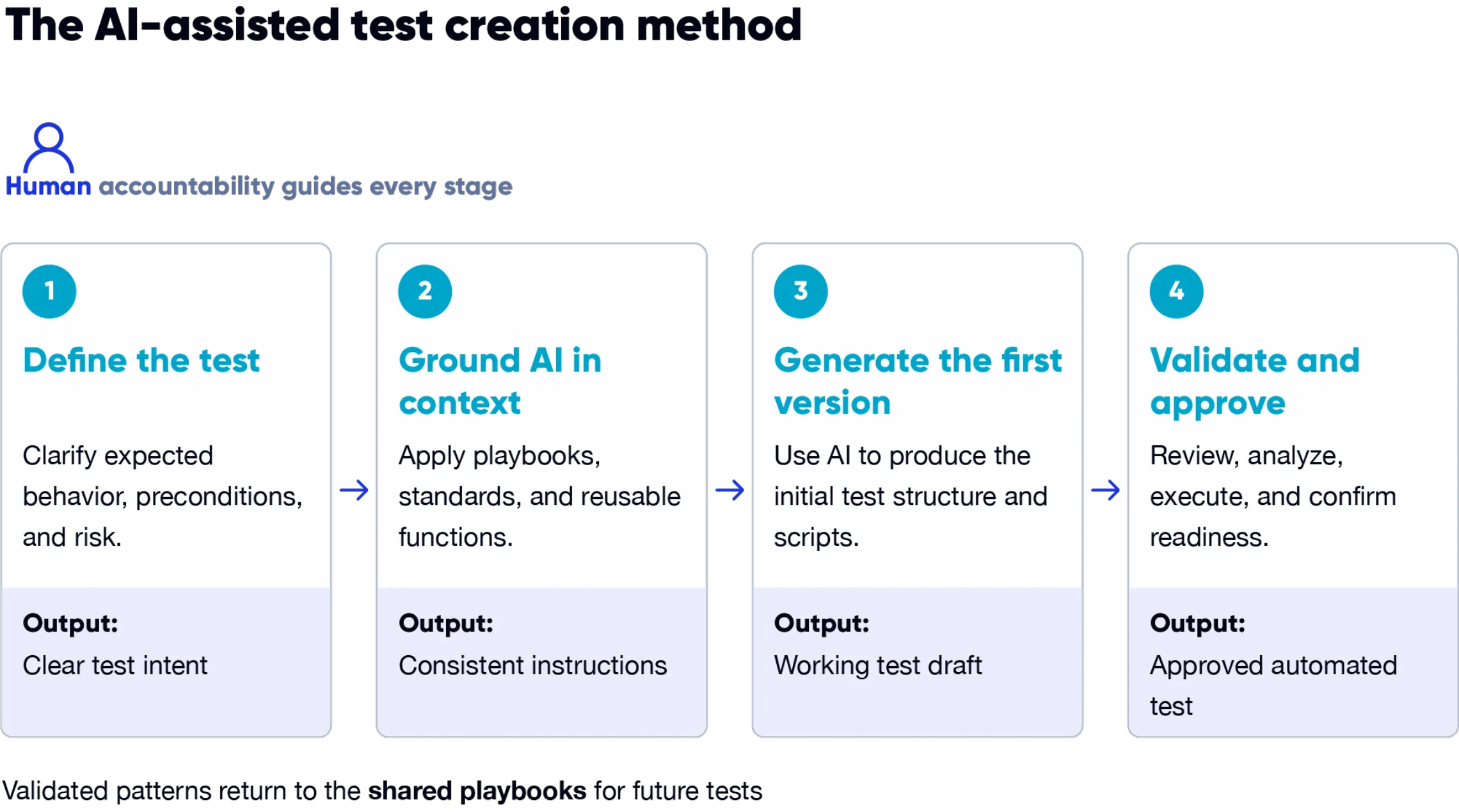
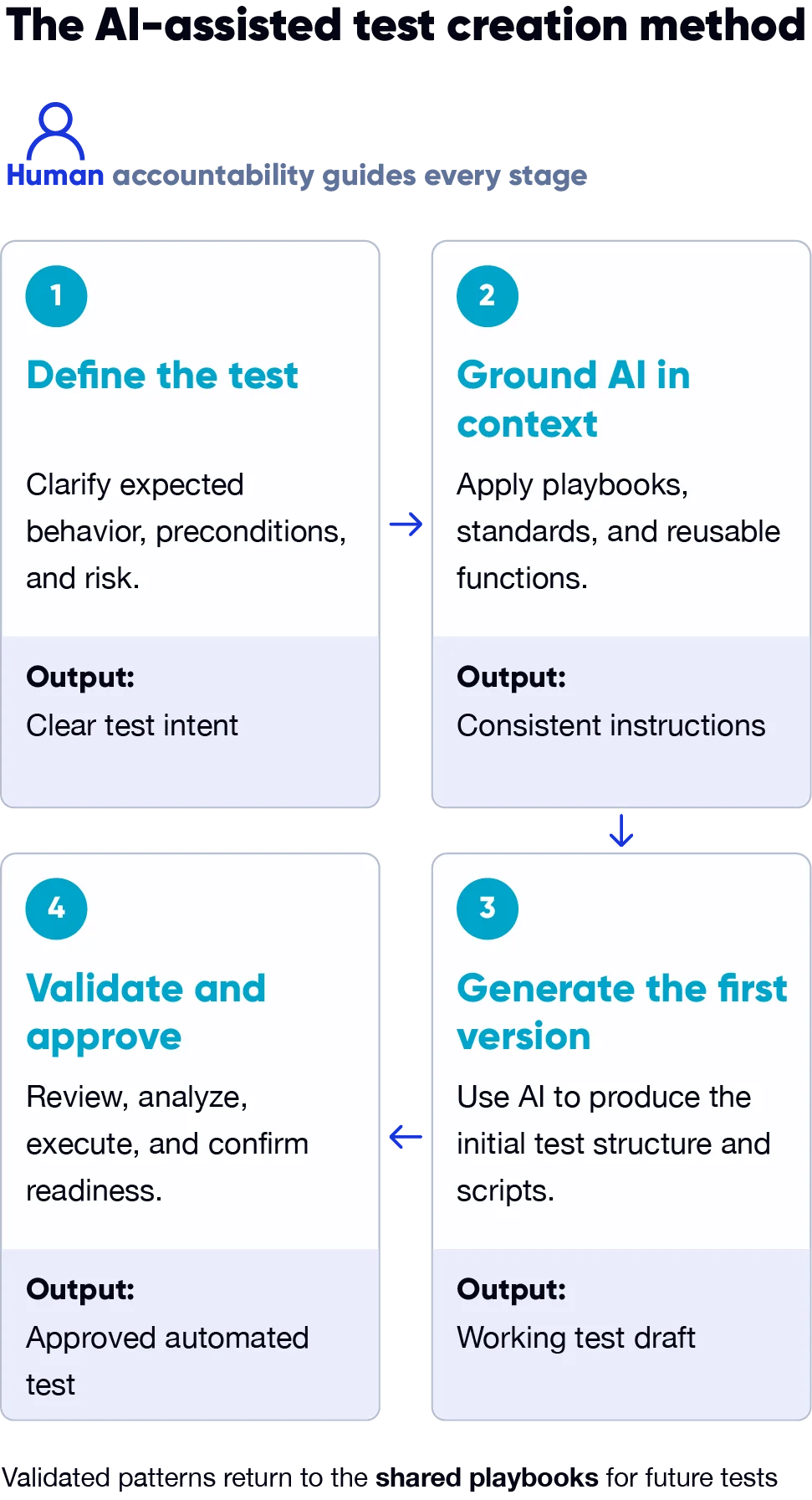
Each playbook combined the context, steps, expected behavior, and quality criteria for a specific testing task with the reusable assets needed to carry it out. As new patterns proved effective, the AssureSoft team incorporated them into shared frameworks, preconfigured functions, technical guidelines, specialized agents and skills, and adoption documentation.
Together, these resources created a shared engineering context. They reduced variation, prevented teams from repeatedly solving the same problems, and made proven practices available beyond the engineers who first developed them.
Think of the steps almost every test needs: signing in and loading a set of documents. Once those existed as shared functions, a new test began at the part specific to the feature. The payoff came a few weeks later, when an interface change that would have required editing dozens of tests was reduced to fixing a single function.
THE CONTROL SYSTEM
Faster generation moved pressure toward review
As engineers produced more code and test automation, review became the next constraint. A larger volume of generated output could overwhelm the same review process or encourage shallow approval.
To protect review quality as output increased, the team expanded the control system around AI-generated work. The evolution can be understood in three stages:
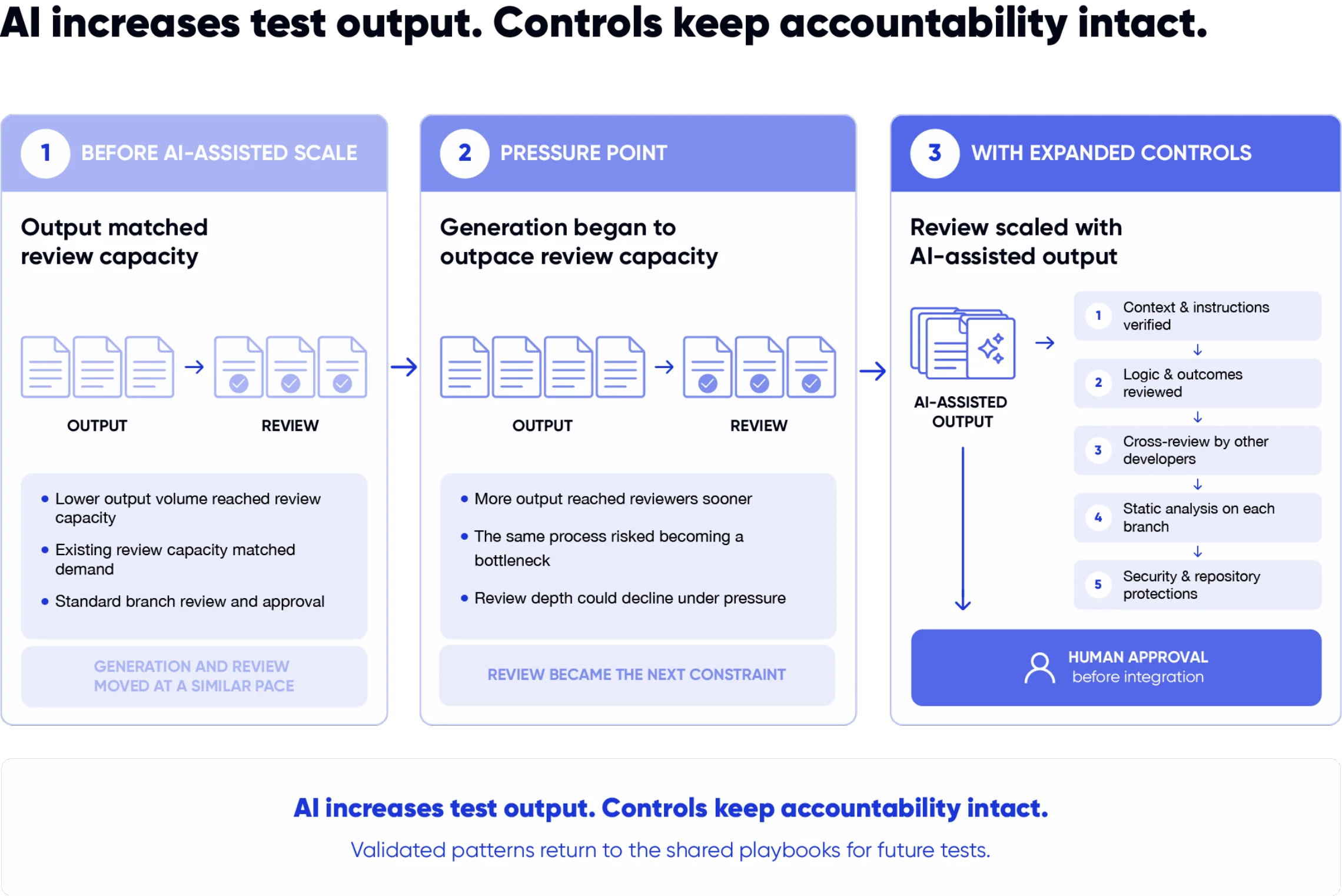
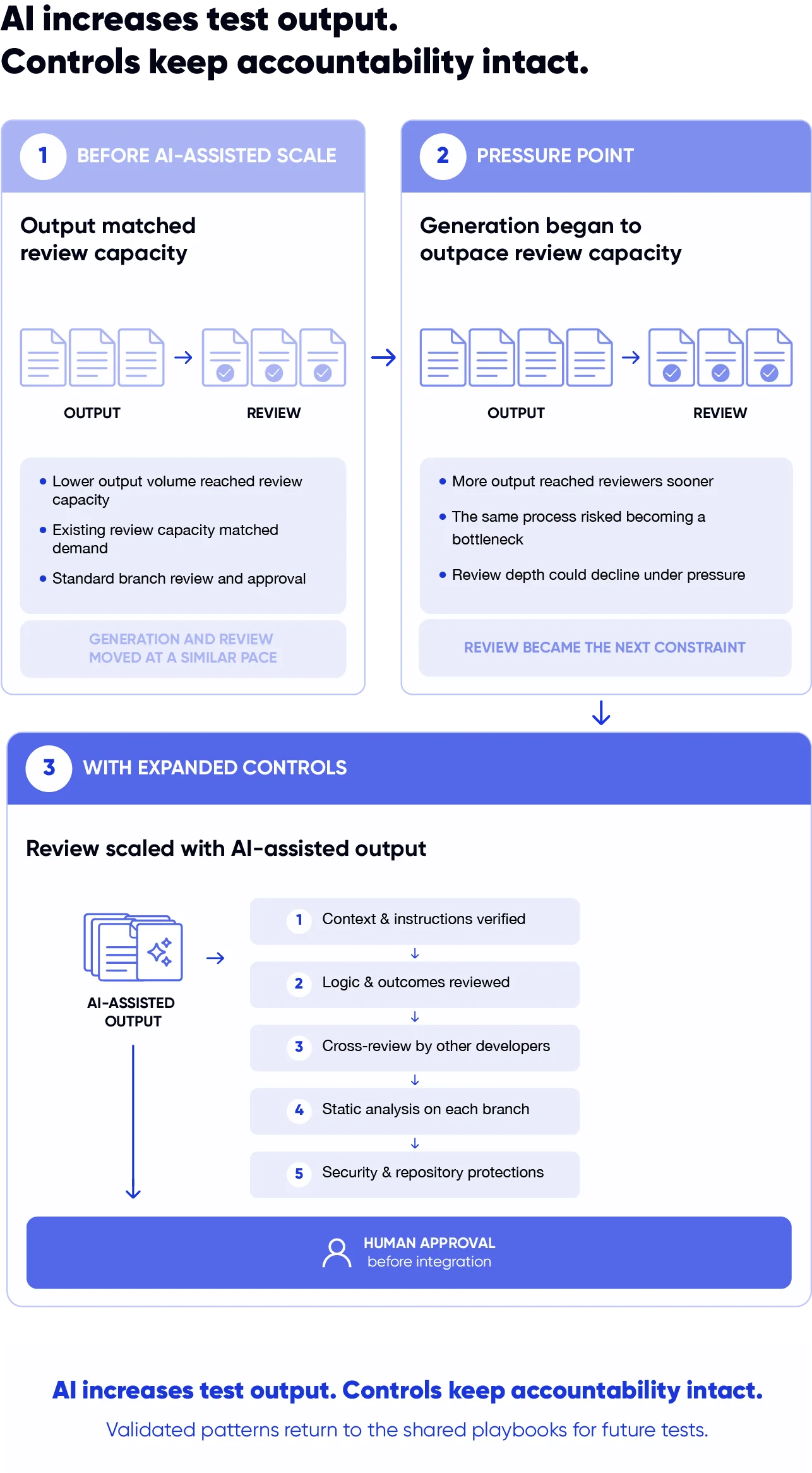
When the first output fell short of the required quality level, engineers refined the context, clarified the request, and reused proven guidance. Senior practitioners still had to decide whether the test was correct, complete, and ready to integrate.
The quality standard for legaltech
Legal software often handles dense documents, sensitive data, connected workflows, and features where subtle defects are easy to miss. A faster first draft of code creates value only when validation capacity grows with it. The client’s process paired generation speed with accountable review, static analysis, and established repository controls.
THE EVOLUTION OF QA
Testing moved earlier, and QA
specialists went deeper
QA specialists took on a broader role as the practice matured. Experienced team members led workshops, supported engineers through one-on-one sessions, refined the test automation method, and helped other groups adopt it.
Their expertise became available across teams instead of remaining concentrated in individual test work.
As other groups adopted the method, coverage spread to more parts of the product, not just the areas the team worked on directly.
More attention to product behavior
With less time spent on setup and repetitive test logic, QA engineers could examine areas that require experience and product judgment:
- Edge cases and unexpected behavior
- Incorrect responses and inconsistent interface elements
- Risks across connected functionality
- Whether a feature met its intended objective
- How a change affected the broader system
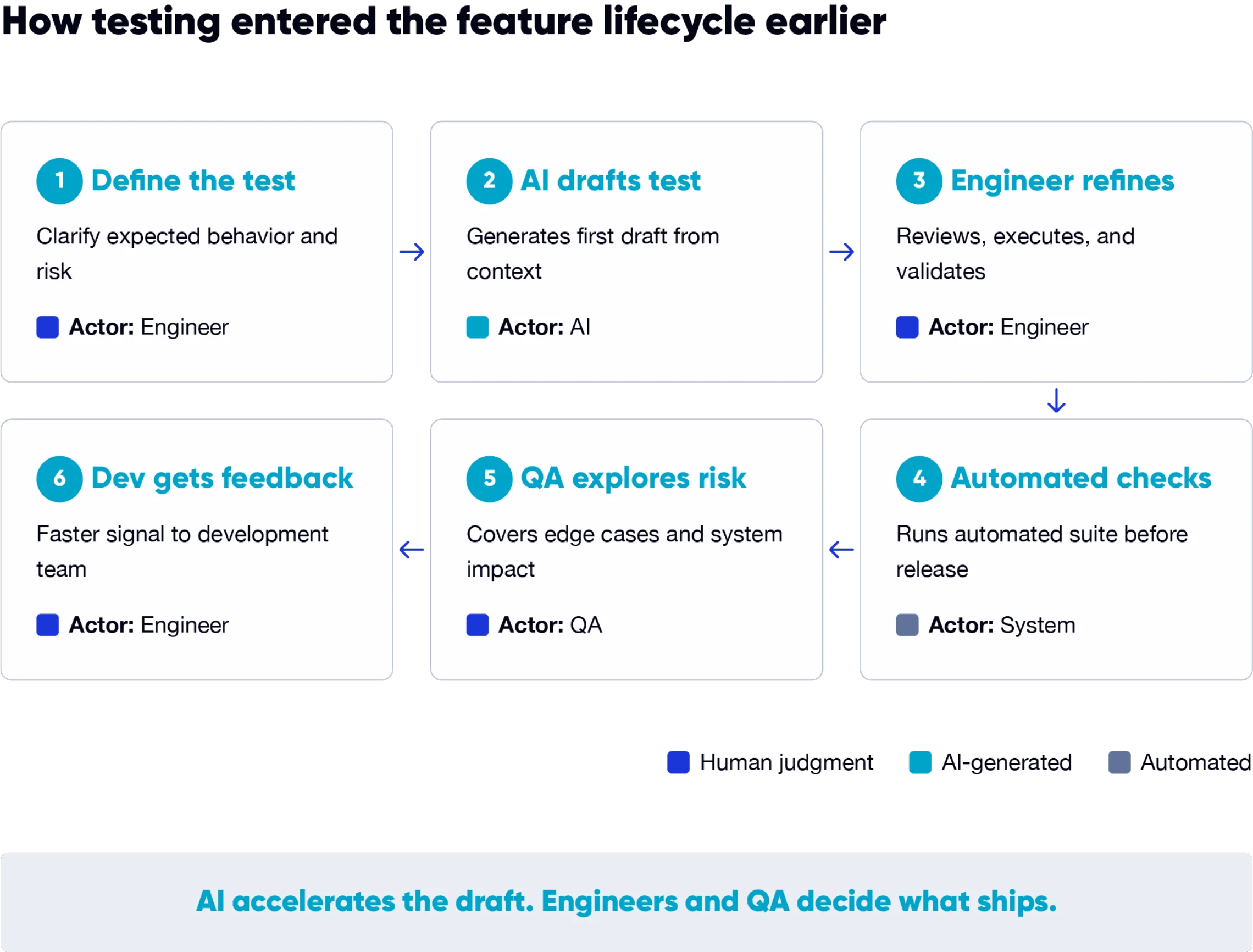
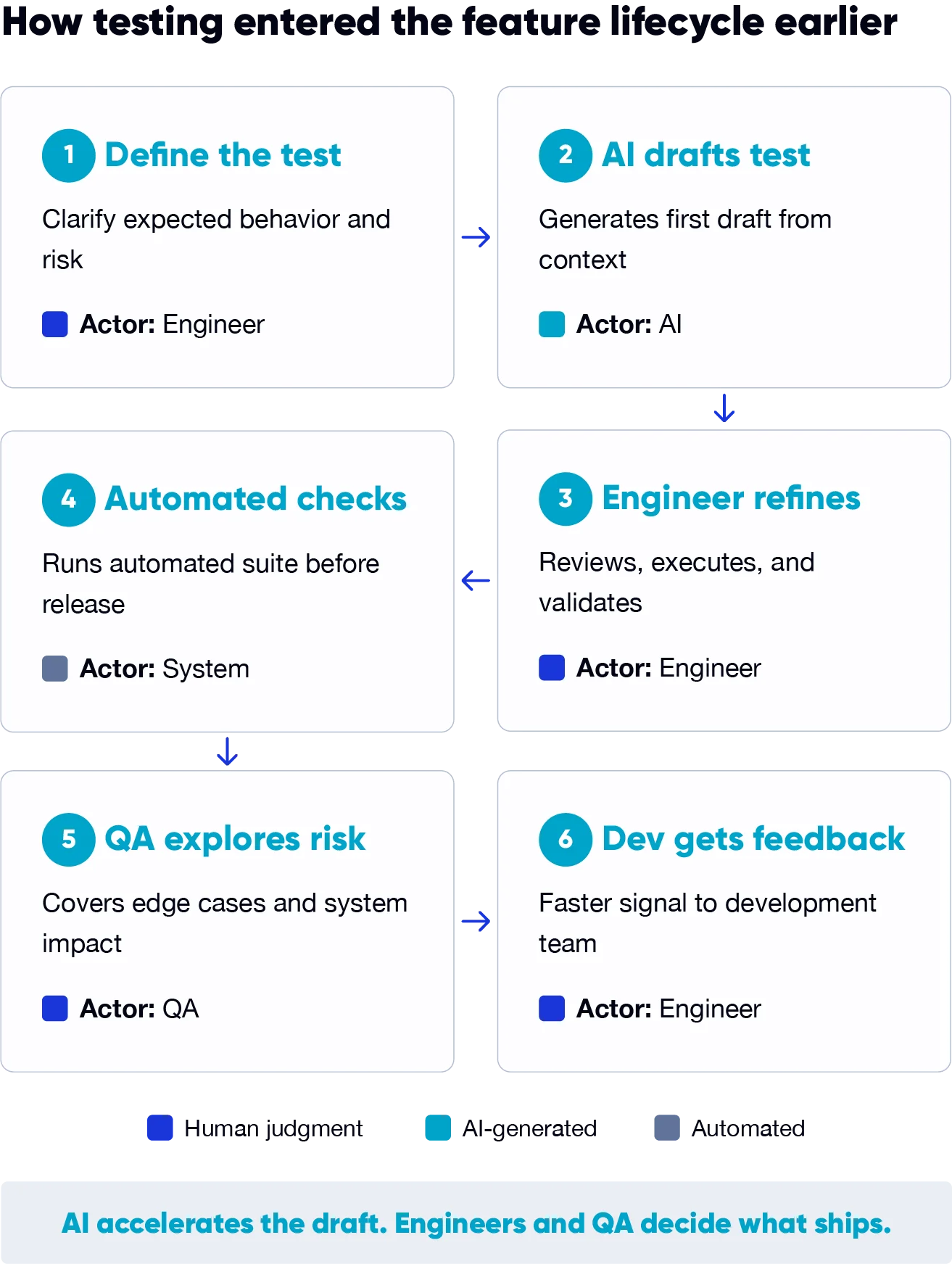
Testing entered the feature lifecycle earlier. Developers received high-quality context while they were still shaping the implementation, and QA gained more time to examine behavior that automation alone could not assess.
Say a developer changes how flagged clauses are shown during a contract review. The automated suite runs before release and, the same day, shows whether the export or the comparison view stopped working. The developer fixes it while the code is still open on their screen. QA then looks at what a script cannot judge: whether labels read the same on every screen, or whether the new view helps someone going through a hundred agreements. By the time lawyers see the feature, it has passed both automated and human review.
THE OUTCOME
Greater test capacity strengthened
release confidence
Observed engineering impact
- Automated tests were created in substantially less time.
- Reusable functions and frameworks reduced repeated work.
- Testing context entered development earlier.
- QA specialists gained capacity for edge cases and system behavior.
- Teams reported greater confidence before deploying changes.
- Teams reported fewer defects in newly developed functionality, while many remaining issues were concentrated in legacy functionality.
Client feedback increasingly highlighted the team’s communication, collaboration, initiative, and cross-team contribution. Engineers proposed scripts, reporting improvements, deployment automation, and ways to reduce future operational work. Their contribution extended beyond delivery capacity to improving the engineering system behind the product roadmap.
Together, these improvements shortened the path from development to release for future features.
A capability that grows with the product
As the method matured, each successful testing pattern fed back into shared playbooks, reusable components, and review practices. That knowledge could then travel to new features and teams, giving engineers a stronger starting point each time. The result was a testing capability that could evolve with the product and expand across the organization.
FOR LEGALTECH LEADERS
Five lessons for scaling AI-assisted engineering
1.
Put AI inside the delivery workflow
Value appears when AI supports real development, testing, troubleshooting, documentation, and review activities inside the team’s existing system.
2.
Treat playbooks as engineering assets
Shared instructions give people and AI the same expectations. Versioned playbooks, frameworks, and libraries reduce variation and preserve hard-won knowledge.
3.
Scale review capacity with generation capacity
Faster output changes where the bottleneck sits. Cross-review, static analysis, branch controls, and final approval need enough capacity to protect release quality.
4.
Bring QA into feature development earlier
Early testing context shortens feedback loops and gives specialists more time for edge cases, connected behavior, and user impact.
5.
Choose partners who improve the system around the work
Specialized engineers create greater value when they operate within product teams, contribute across disciplines, and leave behind reusable practices.
CTO takeaway: AI adoption creates durable advantage when the engineering organization supplies clear context, reusable standards, disciplined review, and people who remain accountable for the outcome.
AI productivity needs human standards
This case shows why access to AI tools is only the beginning.
The productivity gain came from faster test generation, reusable components, and automation embedded into the engineering workflow.
The reliability came from experienced QA specialists, clear playbooks, shared technical standards, code review, automated analysis, and engineers who remained accountable for every deliverable.
That combination allowed the team to increase its test automation capacity without treating speed as the only measure of success.
AI helped the team create more. Human judgment ensured that what they created was worth releasing.
AI Productivity. Human Standards.


To learn how this approach
could work for your team,
contact us