When the right ticket leads
to the wrong work
How senior engineers kept AI-generated work tied to real product needs
AssureSoft expanded delivery for a U.S. financial wellness company. The client had already connected AI to its source code, requirements, and QA. They needed expertise to refine their AI-assisted processes.
The engagement revealed a risk that can emerge even in a mature AI environment: a ticket can be technically accurate and still point the team toward the wrong work. AssureSoft engineers added the context, evidence, and accountability needed to catch that distinction before release.
Key finding: When AI-generated work relies on incomplete or outdated context, a technically accurate requirement can still move delivery in the wrong direction. Experienced engineers know when to pause, investigate, and question the premise before work moves forward into implementation and eventual release.
THE CONTEXT
AI was already part of delivery
The client operates a U.S. SaaS financial wellness platform that employers make available to their employees as a workplace benefit. Through the platform, employees can access financial guidance, savings tools, and credit products provided in partnership with financial institutions. In this context, delivery speed is fundamental, but each change can also affect sensitive financial data, payment activity, or lending decisions.
By the time AssureSoft joined, AI was already supporting several stages of delivery:
- OpenAI Codex, connected to the source code, helped engineers trace system flows and identify components affected by the proposed changes.
- Client-built AI agents generated user stories and effort estimates.
- QA teams used ChatGPT prompt templates, later packaged as reusable skills, to generate test cases and synthetic data.
The client needed additional capacity from professionals who could work effectively within its existing environment while maintaining its standards for technical depth, communication, and control.
AssureSoft brought together developers, QA specialists, and product analysts who could own separate workstreams, build context independently, and make informed decisions when the requirements did not tell the whole story.
What AssureSoft added
Product relevance
Experienced professionals examined the assumptions behind AI-generated user stories and connected the work to current product needs.
Evidence-based decisions
Engineers combined repository context, test results, and operational data before recommending a direction.
Cross-functional capacity
Development, QA, and product analysis moved independent projects forward alongside ongoing production priorities.
Process fit
The team worked within the client’s established AI tools, security controls, and delivery practices.
THE DECISION
One accurate ticket pointed to the wrong work
As the team implemented an AI-generated user story, the work appeared straightforward. The ticket accurately described an existing legacy flow and gave the developer enough detail to complete the code.
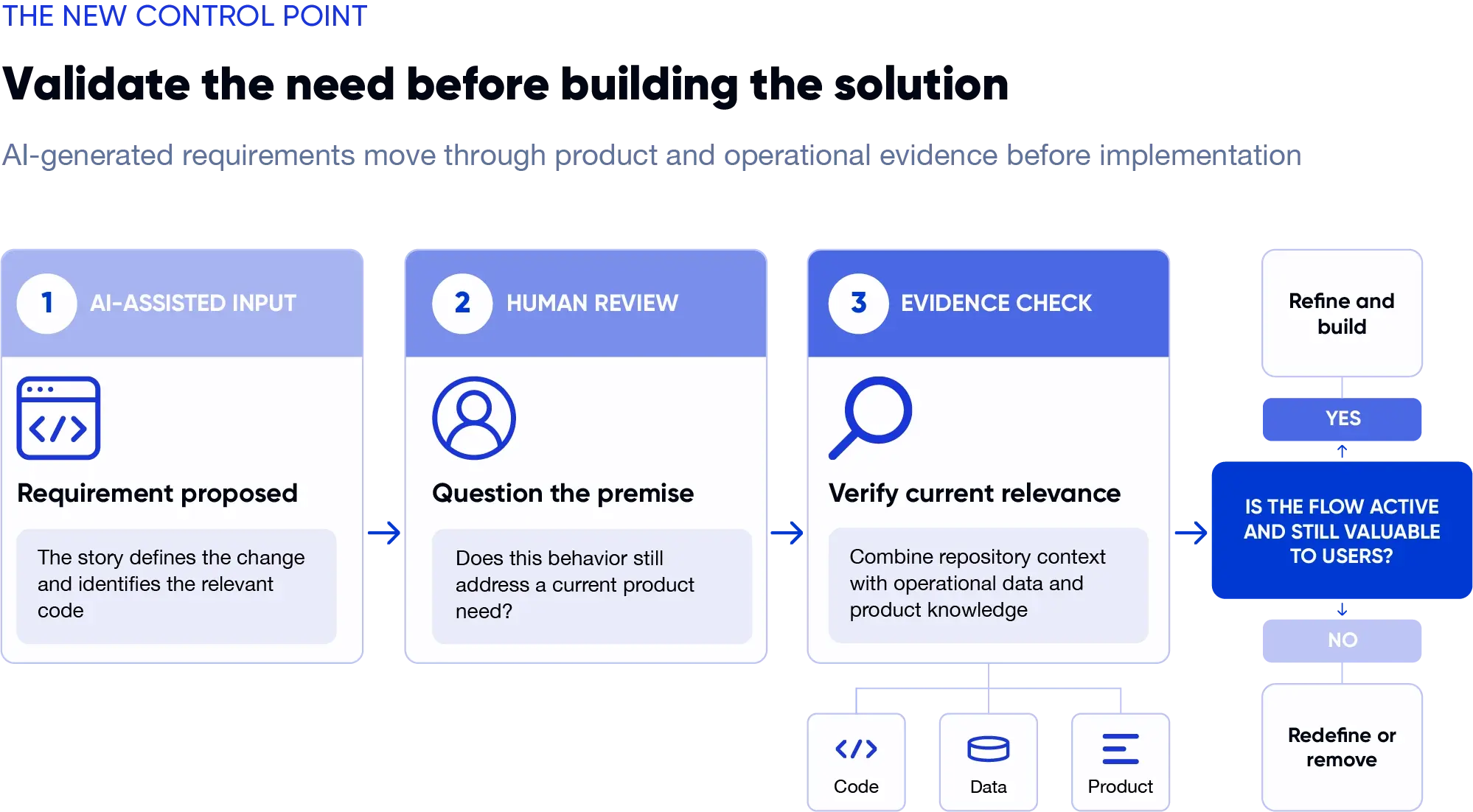
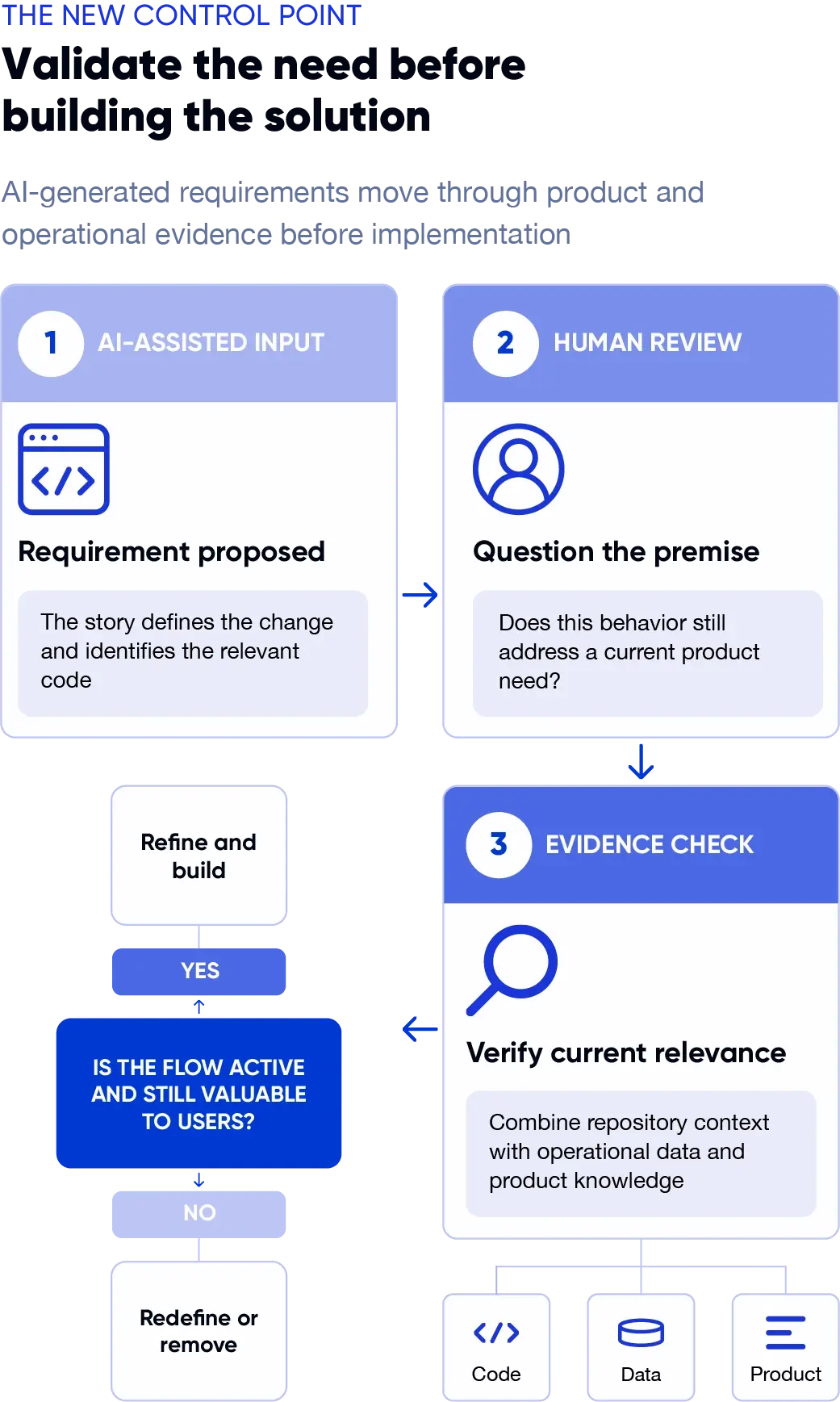
During validation, the AssureSoft QA team questioned whether the flow still served a purpose. They used OpenAI Codex to trace it through the application, then queried the database to look for evidence of customer activity. The path existed in the code, but the data showed that customers no longer used it.
The engineers shared the results with the client’s lead, and the team changed course before release. Instead of extending the feature, they decided to delete the old path and add an earlier check to ensure that future AI-generated requirements would align with the current product and operational data.
Why this mattered
The engineers’ experience showed in their ability to question the task and connect the finding to business needs. Regular communication with the client gave them the product context needed to avoid rework and spot where additional review was necessary.
That response created new evaluation points within the delivery process. AI could continue accelerating requirements and implementation without increasing the risk that outdated assumptions would affect product quality.
This prevented the team from investing more time in a flow customers no longer used. More importantly, it established a repeatable control: validate that a requirement reflects the current product before treating it as work to complete.
THE PARTNERSHIP
What seniority looks like in AI-assisted delivery
The legacy-flow decision showed what the client needed from an engineering partner: senior professionals who could recognize when a technically plausible task required further investigation and turn a software decision into an opportunity to improve the delivery process.
Judgment is a skill that has to accompany each engineer. In cases where the work shifted from one independent project to another rather than progressing through a single, closely integrated partner team, the requirements could be treated as individual tasks rather than as part of a system. A capable engineer could complete the assignment. A stronger one would examine the available information, investigate the surrounding workflow, and bring informed questions into the conversation. AssureSoft’s selection process was designed to identify those abilities before the engagement began.
This evaluation process went beyond ability assessment. Interviews and role-specific exercises examined how candidates built context, communicated uncertainty, supported decisions with evidence, and worked without step-by-step direction. The QA specialists involved in the decision to remove the legacy flow, like the wider AssureSoft team, had demonstrated these qualities during the selection process and continued to apply them throughout the engagement.
Autonomy
Build context before requesting guidance
Critical judgment
Question work that solves the wrong problem
Evidence
Ground recommendations in code, tests, and data
Product context
Connect each task to user and business needs
Communication
Give client leads enough detail to decide quickly
Ownership
Stay accountable when AI contributes to the work
Engineers exceeded expectations when they combined AI proficiency with the judgment to recognize what needed to be questioned, which evidence was missing, and when a convincing output required further investigation.
THE DELIVERY
Trust grew through the work
From the beginning of the engagement, AssureSoft maintained a consistent working culture, focused on autonomy, clear evidence, open communication, and ownership across every part of the project. Engineers took on stalled backlog items while also fixing defects that impacted the experience, making sure to check their assumptions and speak up early when something didn’t feel right. Thanks to this approach, the client was able to improve processes and boost delivery capacity with real confidence.
Payment reliability
The team tackled issues that were disrupting payment accuracy. Some payments could not be matched to the corresponding ACH records, while others were processed more than once or triggered duplicate user notifications. Because these inconsistencies could undermine confidence in the platform, AssureSoft engineers traced and resolved each issue, making payment processing more accurate and dependable.
File ingestion
A manual process for moving files from the server into the database was replaced with an automated ingestion pipeline. Engineers used AI to accelerate the design and implementation of the solution, including the data model, while keeping AI out of the production workflow. Once deployed, files were processed through defined application logic rather than interpreted by an AI model. This allowed the team to move faster during development while keeping the core data flow predictable and controlled.
Backlog capacity
Projects that had been stuck due to a lack of personnel began moving forward. As trust built between teams, AssureSoft added more professionals to the engagement, including developers, QA specialists, and product analysts. This extra capacity helped the client keep up with product development while still addressing urgent production needs.
Together, these workstreams showed how added capacity could improve more than throughput. Engineers resolved production issues, replaced manual steps with controlled automation, and advanced delayed projects while remaining accountable for the decisions behind the work.
The client gained a team that could operate independently within its existing environment without losing visibility into what was changing or why.
“The team moved stalled projects forward, resolved production issues, and automated work that had previously been manual. More importantly, they did it with the autonomy and judgment the client expected.”
- Project Engineering Manager
THE TAKEAWAYS
What CTOs can apply
1.
Review requirements before work begins
Treat an AI-generated story as a proposal until a person verifies that the work is current, necessary, and aligned with the product. Review should start before coding begins, not when the code is ready for a pull request.
2.
Validate assumptions beyond the prompt
Use code traces, database evidence, user behavior, test results, and business context to challenge an AI-generated requirement. Even a convincing answer may still be incomplete if the model lacks operational data.
3.
Keep human controls in critical paths
Use AI to speed up design and implementation while keeping financial transactions and data movement predictable, testable, and visible in production.
4.
Evaluate partners on engineering judgment
Assess whether engineers can question assumptions, build context independently, and support recommendations with evidence. Tool proficiency alone does not show whether a partner can protect product relevance and release quality.
5.
Preserve accountability as speed increases
Make an engineer responsible for the decision behind each release. AI can generate requirements, suggest implementations, and support testing, but release ownership remains human.
AI productivity needs human standards
In a mature AI environment, an engineering partner needs more than technical skills and advanced tools. Engineers must be able to integrate into established workflows, quickly understand the product, ask questions when evidence does not align with the task, and be accountable for what goes into production.
AssureSoft engineers increased delivery capacity while working smoothly within the client’s AI-assisted workflows. They used their judgment when making decisions about the output: what needed checking, which evidence was trustworthy, when to flag a risk, and whether the work belonged in the product or should be removed before release.


To learn how this approach
could work for your team,
contact us