AN AI-POWERED FRAMEWORK FOR SOFTWARE TEAMS
The missing layer in AI adoption
From AI access to AI impact
A practical case study on how AssureSoft turned AI adoption into a measurable operating model for software teams. It shows the methodology, leadership practices, and visibility systems that helped move AI from experimentation into daily engineering work.
How AssureSoft turned tool availability
into measurable engineering velocity.
What we discovered through months of structured learning and the 3-phase system that helped turn AI into a daily engineering practice.
100%
Increase in team output in 90 days
100%
Team adoption rate achieved
70%
Average productivity gain across all engineers
Access alone doesn’t create transformation
Many engineering leaders assume that giving developers access to a powerful AI tool will naturally lead to fast adoption. Our experience showed something more important: the impact of these technologies depends on the operating model around them.
We ran this transformation internally with one engineering team of around 50 developers. They received full access to Claude, Anthropic’s advanced AI model, with no limits or restrictions. They were free to see how AI could help with their actual engineering tasks.
In the first stage, we got a good sense of where things stood. Some people used the tool a lot, while others barely touched it. This wasn’t because they weren’t interested or capable. The real issue was that AI hadn’t been built into how the team planned, reviewed, or measured their work.
AI could generate output, but the team still needed a shared standard for when to trust its results, when to challenge them, and how to turn those suggestions into reliable engineering decisions. Good engineers need more than just access; they need clear examples, a shared way of working, support from leaders, and practical guidance on using AI in their daily routines.
The real problem with slow adoption wasn’t wasted licenses. It was lost speed. Every sprint without a solid AI workflow meant missing opportunities to deliver faster, reduce the backlog, and figure out how to stay competitive in a changing field.
“We thought giving them an expensive, powerful tool for free would be enough motivation. That was our mistake.”
Three phases.
One operating model that scaled
Phase 01 · Weeks 1–4
Open access and exploration
We gave the team full access and encouraged experimentation. The idea was simple: give engineers freedom to explore where AI could create value in their actual work. This respected developer autonomy, gave us a clear baseline, and helped us see how differently people approached the tool when no shared workflow was in place.
Result:
Adoption remained inconsistent. The clearest insight was that AI cannot depend solely on individual initiative. It needs to be designed into the engineering process.
Phase 02 · Weeks 5–8
Architecture + methodology
We assigned a principal architect to lead the adoption effort. The team introduced Spec-Driven Development, a methodology designed around AI workflows. By requiring clearer specifications before generation, SDD gave engineers a stronger way to guide the tool and connect its output to project requirements.
Result:
Usage accelerated, with adoption nearly doubling every two weeks as SDD moved from training sessions into real sprint work.
Phase 03 · Weeks 9–12
Visibility + clear objectives
We built dashboards to understand adoption patterns and support each team's progress. Then we set a clear team goal: everyone should reach a healthy, consistent usage range by the end of the month. Team leads helped reinforce the vision and made sure adoption was tied to better engineering habits.
Result:
We reached 100% adoption, and development speed doubled in the first quarter.
What gets measured gets adopted
The single most impactful decision was building a visibility layer. Team leads could see, at a glance, whether AI was becoming part of each developer’s real workflow.
We created a daily usage heatmap that helped identify adoption patterns across teams. Instead of measuring license activations, we looked for sustained usage signals indicating that AI was being integrated into daily development work. Low usage helped us identify where more support, examples, or coaching were needed. Unusually high usage helped us spot where clearer workflows could improve efficiency.
The dashboard was not designed as a surveillance mechanism. It was a coaching tool. It helped team leads understand where adoption was gaining traction, where support was needed, and which practices could be shared across teams.
When team leads could review adoption during weekly standups, AI became a shared capability rather than an individual experiment. The final target was clear and achievable: every developer consistently using AI as part of their engineering workflow by the end of week 12. Every team reached this goal.
Daily usage heatmap
Activity per developer - Pre-intervention through phase 3
dev_alpha
dev_beta
dev_gamma
dev_delta
dev_epsilon
Activity index: average meaningful AI interactions per working day (1 = rare use · 5 = fully integrated into daily workflow). Measured across 50 engineers over 12 weeks.
Representative sample of the 50-engineer usage heatmap.
Usage
Story points showed the impact
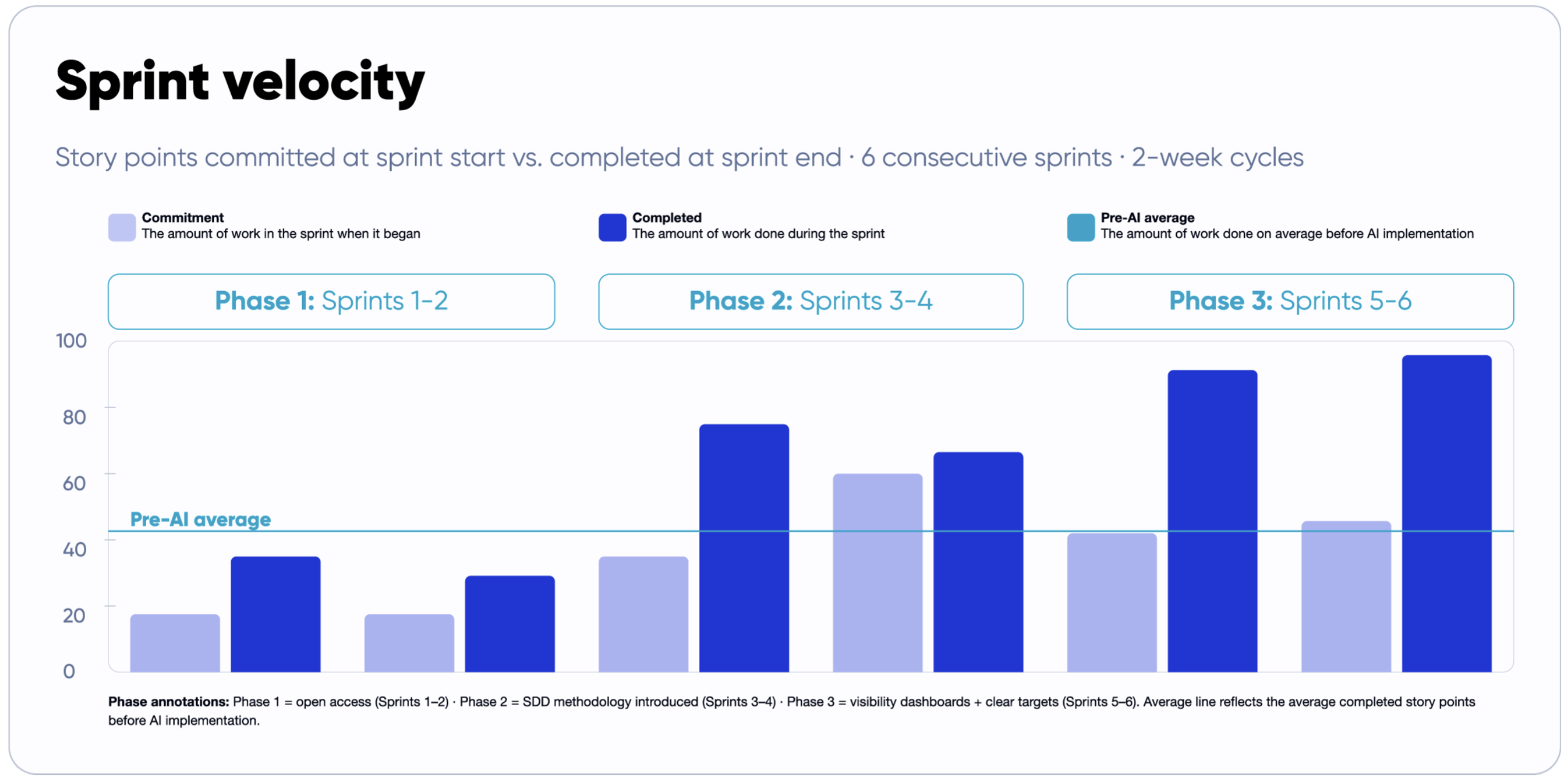
We focused on two key delivery metrics: how many tickets the team closed per sprint and how many story points were completed.
The engineering manager focused on understanding whether AI-assisted workflows could help engineers complete more work and integrate their knowledge on the project, while still applying the same judgment, review discipline, and ownership expected in production software. Across participating engineers, the results showed meaningful and sustained improvement.
Sprint delivery: before vs. after AI adoption
Average story points completed per sprint, measured across participating teams · Until Sprint 6
| TEAM | AVG SP BEFORE | AVG SP AFTER | SP GROWTH | TICKET GROWTH |
|---|---|---|---|---|
| Team 1 | 38 SP | 82 SP | +116% | +79% |
| Team 2 | 46 SP | 90 SP | +96% | +55% |
| Team 3 | 51 SP | 95 SP | +86% | +37% |
| All teams average | 45 SP | 89 SP | +98% | +57% |
Story points measure delivery capacity. Ticket growth measures the increase in completed tickets. Both metrics were calculated across the same participating teams and compared before vs. after AI adoption.
89 SP
Across participating teams, average sprint delivery increased from 45 to 89 story points within three months.
3 months
The most dramatic improvement happened within a single quarter once the methodology and accountability systems were in place.
The five levers that drove adoption
1.
Assign an AI champion with actual authority
Designate a senior architect or principal engineer whose explicit mandate is to upskill the team. Not a committee. One person is accountable for the outcome.
2.
Build a usage visibility layer and share it with leads
A per-developer daily usage heatmap, shared with team leads, transformed AI usage from optional to expected. Clear targets (“everyone in the green zone by March”) created a shared finish line.
3.
Weekly peer showcases, not top-down training
Every Monday, 3 developers present how they use AI in their day-to-day work. No slides required. This creates social proof and spreads practical techniques faster than any formal course.
4.
Maintain human review gates
AI-generated code still required a mandatory two-person review before merge. Copilot was used for a first-pass automated review, but human judgment remained the standard for quality, security, and fit. The result: AI errors that reached production became rare within months.
5.
Adopt a single, team-wide AI methodology
We chose Spec-Driven Development (SDD), a workflow in which structured specifications are generated first, providing the AI with rich context before code generation begins. This reduced hallucinations dramatically.
The developer profile has fundamentally changed
AI adoption changes not only how developers work but also what you should look for when hiring.The most important skills from five years ago are no longer the limit.
The output developer
Writes unit tests, boilerplate, and repetitive logic manually
Value measured by lines of code or tickets closed
Resists workflow changes when personally proficient
Relies on individual memory of codebase conventions
The AI-augmented engineer
Strong analytical and critical thinking, spots what AI gets wrong
Provides rich, structured context; reviews AI output skeptically
Proactive about workflow improvement, not just task completion
Technical depth to know when to override AI recommendations
The most important metric: release date moved up by months
The release timeline was accelerated by several months. This was a real business result.An earlier release meant earlier revenue, faster market feedback, and more opportunitiesto improve future processes.
What speed makes visible
Faster delivery was just the beginning
When we doubled our speed, a new challenge appeared: the product team couldn’t keep up with requirements. Adopting AI in engineering revealed this next bottleneck.
The next step is to bring AI-powered prototyping tools right into the product and UX/UI process. Designers can create interactive prototypes with AI tools, and engineers can use those prototypes as a stronger foundation for code generation. This makes the gap between planning and building much smaller.
The mindset shift has happened: the team is no longer asking whether to use AI. They’re asking how far it can go.
AI productivity needs human standards
AI can help engineering teams move faster, but speed alone is not the standard. The real value comes when engineers know how to blend the technical answers with creative ideas, guide the tool, question its output, protect quality, and stay accountable for what ships.
That is the operating principle behind this AssureSoft model: AI should increase engineering capacity without lowering expectations for the work, helping teams move with greater clarity, discipline, and ownership.